What intake paperwork costs a small estate practice
Intake is where a small estate practice types the same facts again and again. Here is how to put a number on it before you automate anything.
A small estate practice rarely loses billable time in one big piece. It loses it in dozens of ten-minute pieces, and intake is where most of them start. Lawyers are billing more than they used to: Clio’s 2026 report has lawyers recording 3.4 billable hours a day, 53% more than in 2016. That still leaves more than half of an eight-hour day for everything else, and intake paperwork is part of the everything else.
Where the intake hours go
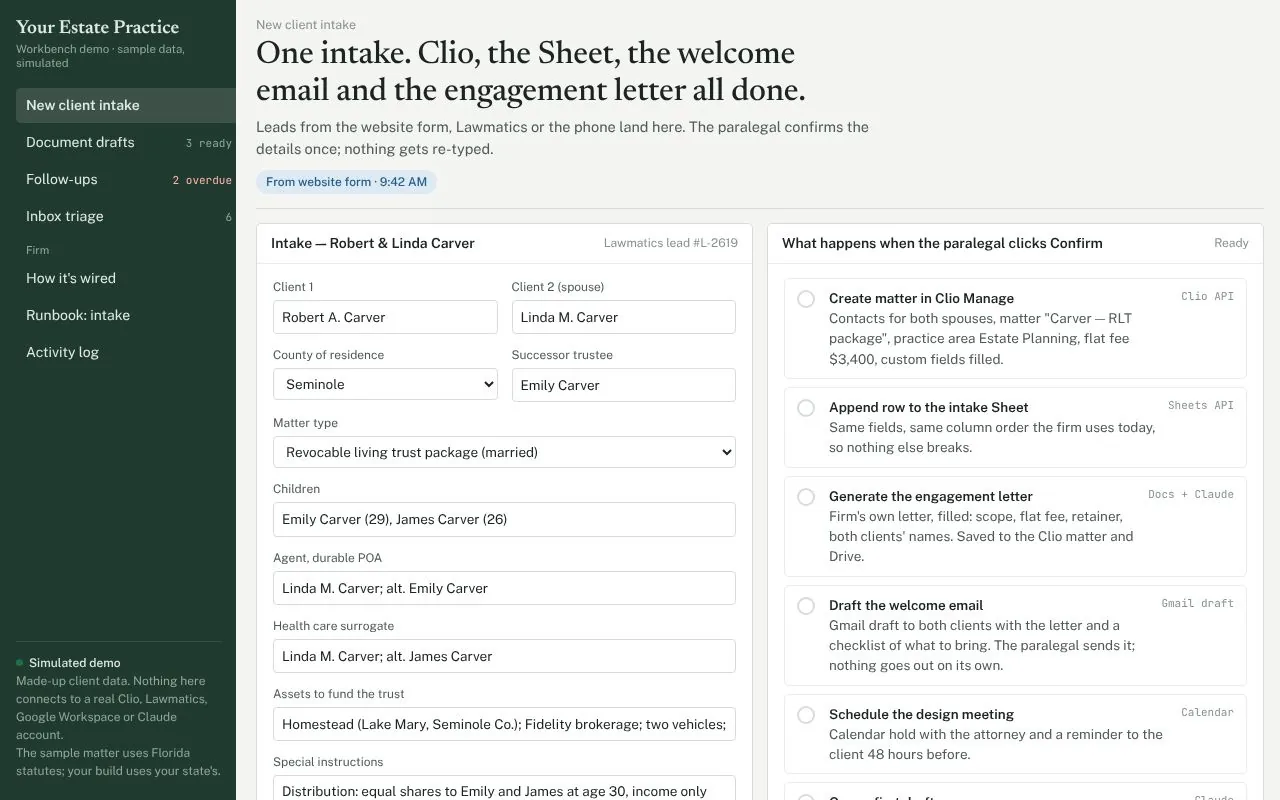
Take one routine matter, such as a revocable trust package. The consultation ends, and the same facts get typed again: into the intake form, into Clio, into a spreadsheet, into the engagement letter and into the welcome email. Nobody does this badly. Each tool simply wants its own copy of the client’s name, the fiduciaries and the matter type. Counting those re-types is the first thing the Sable Law scoping call does, and four or five is typical.
“Solos and lawyers in small firms often have to do their own admin.”
Stephen Embry, Above the Law, on Clio’s 2026 Legal Trends Report, Oct. 28, 2026
In a firm of one to five attorneys, that admin lands on both the paralegal and the attorney. The arithmetic is short. At eight new matters a month and 75 minutes of intake paperwork each, that is 10 hours a month and 120 hours a year. Those inputs are examples. The number that matters is your own, and it takes about ten minutes to measure on one real intake.
Every re-typed field is another chance for the engagement letter to go out late.
The waiting costs as much as the typing
Re-keying is visible. The waiting is easier to miss: the days between the consultation and a signed engagement letter, a retainer that has not arrived, a client who went quiet and a firm that finds out when the client calls, annoyed. None of it shows up as billable time on the day, and all of it comes due later.
Read the headline number with care
Clio projects that utilization, the share of the day recorded as billable, will reach 42.2% in 2026, up from 39.1% in 2025. Its release adds that 85% of legal professionals report some AI adoption at their firms, up from 79% in 2025, and Embry reports that adopters recorded about 8% more revenue per responsible lawyer, roughly $1,772 a month.
“Clio is measuring its own customers using its own products.”
Stephen Embry, Above the Law, Oct. 28, 2026
Embry adds that the analysis is observational. Treat these figures as a direction to check against your own intakes, and keep your own before-and-after numbers.
What changes when the facts are confirmed once
Sable Law connects Clio, Lawmatics, Google Workspace and Claude. A lead arrives from a website form, a Lawmatics lead or a phone message and lands on one intake screen. The paralegal confirms the facts once, and nothing runs until she does. Then seven steps run: the matter and contacts in Clio, the intake log, the engagement letter, the welcome email draft, the meeting and reminder, the first drafts, and the follow-up clock.
Everything that comes out is a draft. Emails are saved as drafts, documents are saved to the matter, and an attorney approves and signs. That is also where the professional rules sit. ABA Formal Opinion 512 says lawyers should not rely on generative AI output “without an appropriate degree of independent verification or review of its output.” Your state bar may have added its own guidance, so check it before you decide anything.
Measure one intake before you buy anything
- Pick one routine intake from last month and walk it from first contact to opened matter
- Write down each person who touched it and each place the same facts were typed
- Count the re-types and put your paralegal’s own time estimate on them
- Count the days between the consultation and the signed engagement letter
- List who approves each output, so review stays with a person
Sources
- Above the Law, “Clio Says AI Is Boosting Billable Hours: Maybe I Was Wrong. Or Maybe Not.” by Stephen Embry (Oct. 28, 2026)
- Clio, “2026 Legal Trends Report reveals record gains in billable time as AI reshapes law firm economics” via Yahoo Finance (Oct. 26, 2026)
- LawSites, “In First Ethics Ruling on Gen AI, ABA Says Lawyers Must Have Reasonable Understanding of the Technology” by Bob Ambrogi (July 30, 2024)
Bring one real intake. We time it with you.
The free scoping call is 60 minutes by video or phone. We walk one real intake and one inbox morning with sample or redacted data, and within 48 hours you get a two-page memo with what to fix first and a fixed quote in writing. If you do not go forward, you keep the memo.
Book the free scoping call