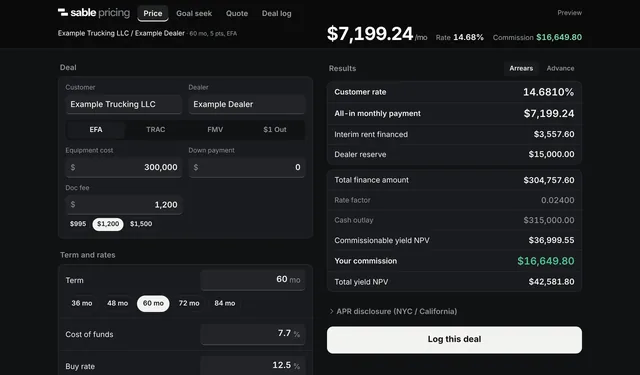
EFA, TRAC, FMV or $1 buyout: how the structure changes the payment and the commission
Same equipment, same term, same two points. The structure decides the payment and the commission, and most reps find out at funding.
Take one piece of equipment, one term and the same two points of dealer participation, and price it four ways: as an EFA, a $1 buyout lease, an FMV lease and a TRAC lease. You get four payments and four commissions. Reps who do not know why get caught twice: by the customer who asks why the lease is cheaper, and by the funder who pays a smaller reserve than expected. ELFA’s latest survey puts new business volume growth in the $1.3 trillion equipment finance industry at 6.8% in 2025, up from 3.1% in 2024.
What each structure actually is
An EFA is a loan. The customer owns the equipment from day one, the lender holds a security interest, and the payments take the balance to zero. A $1 buyout lease has the same economics on lease paper: the lessor holds title through the term, then sells the equipment to the customer for a dollar. The payments are nearly identical. The quote looks different, because a loan shows a rate and a lease shows a money factor.
An FMV lease has a residual. The payments cover the equipment cost less what the lessor expects it to be worth at the end, and the customer can return it, buy it at fair market value or keep paying. A TRAC lease is the vehicle version, with the residual written into the contract. If a truck sells for $5,000 more than that number the customer gets the difference; if it sells for $3,000 less, the customer pays it.
“In a TRAC lease, the fleet operator takes on the risk and potential reward of the vehicle’s eventual sale price.”
Alliance Fleet Solutions, TRAC lease vs. fair market value lease for trucks, May 2026
Mileage pushes fleets the same way. The same guide notes that FMV leases typically cap mileage at 100,000 or 110,000 miles, while TRAC leases suit routes over 120,000 miles a year, and it puts FMV residual risk on the lessor.
Why the payment moves
The payment amortizes the cost less the residual. On an EFA or a $1 buyout the residual is zero, so the whole cost is in the payments. On an FMV or a TRAC the residual comes off first, and the payment drops with it. The ownership structures are the expensive ones per month.
“EFA payments are typically higher than FMV payments for the same equipment and term length.”
Financial Partners Group, EFA vs. FMV, May 2026
The residual also changes what the points are worth.
Same cost, same term, same points. Four payments, four commissions.
Why the commission moves too
The dealer reserve is the spread between the buy rate and the customer rate, earned on the balance the payments pay down. On an EFA that balance is the full cost. On an FMV or a TRAC, the residual sits outside the payment stream, and on most programs outside the reserve calculation as well. Two points on a deal with a 30% residual are earned on something close to 70% of the cost, so the reserve comes in lower than the same two points on an EFA.
Funders treat the residual differently. The rep who quotes five points on all four structures and expects the same commission on each will be wrong on three of them. ELFA puts industry spreads at 2.99% on pre-tax yields of 7.39%, so a reserve that lands below the quote is a visible miss.
Tax is why the customer picks one
Ownership structures put the equipment on the customer’s books, and that matters this year. U.S. Bank notes that the One Big Beautiful Bill Act reinstated 100% bonus depreciation for 2025 and beyond, and the 2026 Section 179 expense limit is $2,560,000, phasing out at $4,090,000. A customer who wants that deduction will ask for the EFA or the $1 buyout. A customer who wants the lower payment and a way out at the end will ask for the FMV. Which fits is a question for their accountant.
What the quote has to get right
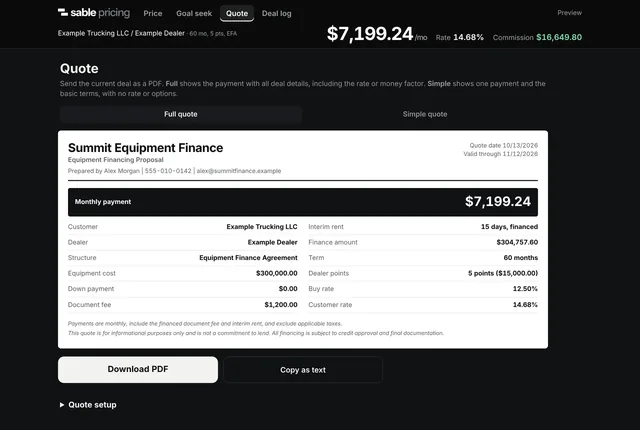
- The structure named on the quote, with the residual or purchase option in dollars
- A rate on loans and a money factor on leases, with cost of funds and yield never on the page
- Payment, reserve and commission from the same inputs on every structure, so switching from EFA to FMV re-prices all three at once
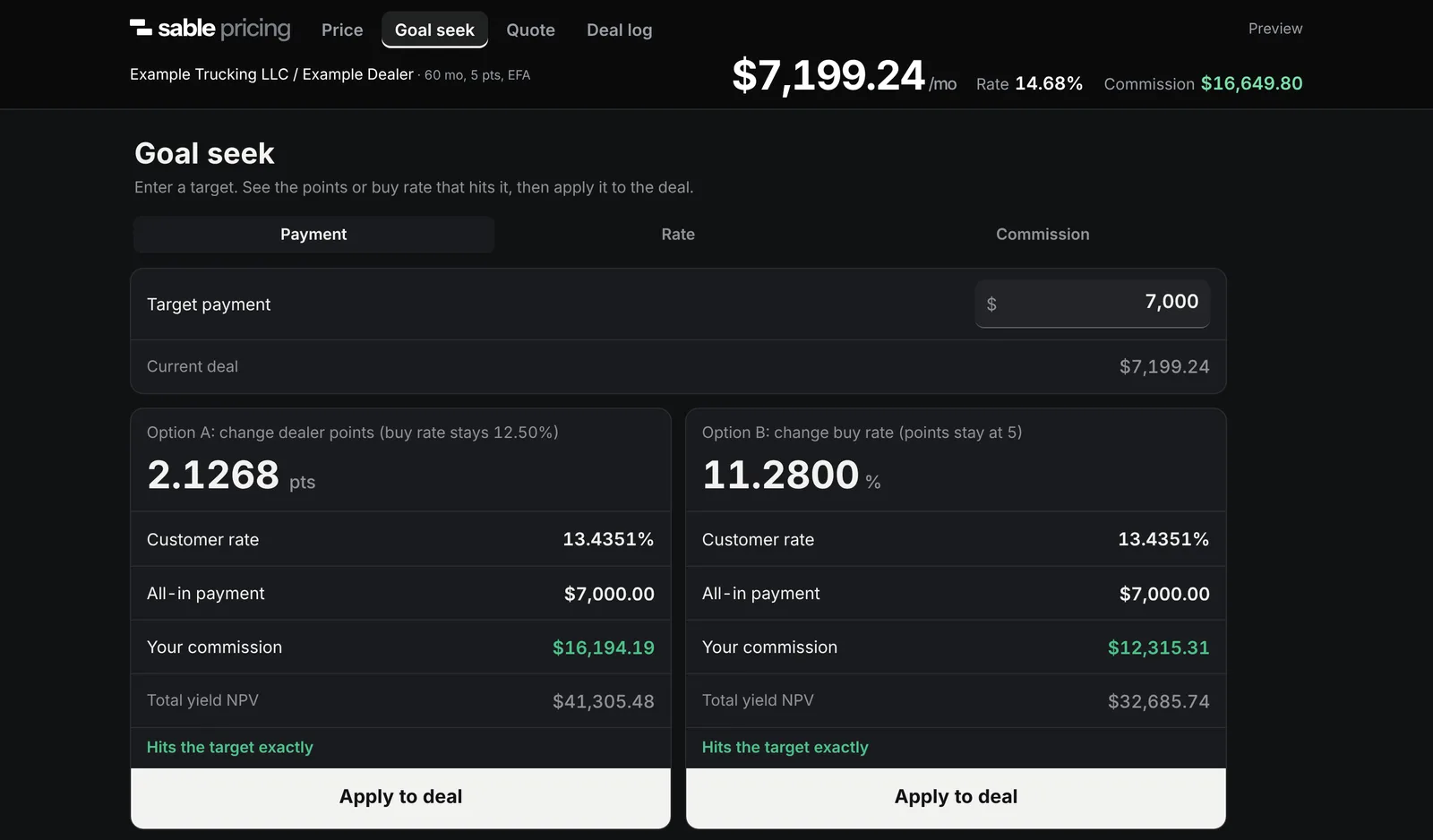
- Goal seek that solves for points or buy rate inside the structure the customer asked for
- Who carries the residual risk, written down before the customer signs
Sources
- ELFA, “Survey of Equipment Finance Activity Reports 6.8% Growth in New Business Volume in 2025” (Oct. 14, 2026)
- Alliance Fleet Solutions, “TRAC Lease vs. Fair Market Value Lease for Trucks: 2026 Commercial Guide” (May 4, 2026)
- Financial Partners Group, “EFA vs. FMV: Understanding the Two Most Common Equipment Financing Structures” (May 4, 2026)
- U.S. Bank, “Maximizing your deductions: Section 179 and Bonus Depreciation” (updated July 2026)
Every structure, priced the way your team sells it.
Sable Pricing is set up with the deal structures your team sells, so the payment, reserve and commission come from the same inputs on every one of them. Loans show a rate, leases show a money factor, and goal seek solves for the points or buy rate inside the structure the customer asked for. On any phone, tablet or computer.
See Sable Pricing