The first five minutes decide who signs an injury case, and what comes after
Only a quarter of law firms answer an online lead in under five minutes. Here is what that means for a small injury firm, and what we built for the hours after the lead.
A person hurt in a crash fills in two or three contact forms and then waits. The firm that answers first gets the first conversation, and most firms do not answer fast. In Hennessey Digital’s 2025 study, 25% of law firms replied to online leads in under five minutes, and the median reply took 13 minutes. For a small injury firm, that gap is the easiest place to win a case, and the case is not over when the client signs.
- 25 replied in under 5 minutes
- 49 replied later
- 26 never replied
What the response-time studies show
Hennessey contacts more than 1,300 U.S. law firms each year through their web forms and times the reply. The share answering within five minutes was 18% in 2023, 28% in 2024 and 25% in 2025. These samples cover personal injury, criminal defense and other practice areas, so read them as a law-firm number, not an injury-only number.
“Twenty-six percent of law firms don’t respond to online leads.”
Hennessey Digital, 2025 Lead Form Response Time Study
The same study says the median response time “remains steady year-over-year at 13 minutes.” It was 20 minutes in the 2023 study. A firm that answers in two minutes beats the median by 11 minutes and is ahead of at least three firms in four.
Being first does not require a bigger firm. It requires an answer that does not wait for someone to be free.
What we found when we looked at Florida injury sites
We opened about 110 Florida injury-firm websites in a real browser, across Tampa Bay, Miami, Orlando and Jacksonville, and looked for a chat or intake widget. About two in three already run one, and the most common were Intaker (13 firms), Ngage (11) and ApexChat (10). Thirty-one had no chat or AI intake that we could find, only a contact form.
A widget is not a promise of speed, and a contact form is not proof of slowness. The scan only says where the easy gap is likely to be: firms whose first impression is a form and a wait.
The clocks start before the client signs
Florida has changed the numbers an intake has to catch. Greenberg Traurig’s summary of HB 837 says the law is “reducing the statute of limitations period for general negligence actions from four years to two years” and that it applies to causes of action accruing after March 24, 2023, the effective date. Auto cases also run on PIP timing.
“within 14 days after the motor vehicle accident.”
Fla. Stat. 627.736(1)(a), the window for initial services and care to qualify for PIP medical benefits (2024)
The same section pays up to $10,000 when a listed provider determines an emergency medical condition and limits benefits to $2,500 when one does not. A lead who waited three weeks to see a doctor is a different case from one who went in on day two, and the intake is the first place anyone can ask.
- Day 0The crashThe intake asks the date first
- 14 daysto start care for PIP medical benefitsFla. Stat. 627.736(1)(a)
- 2 yearsto file a negligence claimFor claims accruing after Mar. 24, 2023; was 4 years
Where we chose not to compete
Demand letters and medical chronologies are a crowded, well-funded lane. Supio’s 2025 release says its “Instant Demands drafts a detailed demand letter, complete with ICD codes and firm branding, ready for review in minutes.” EvenUp is in the same lane. We would not out-build them, and a small firm does not have to choose between them and us.
What a firm with a contact form is missing is the front end and the long middle. That is where we built.
What we built
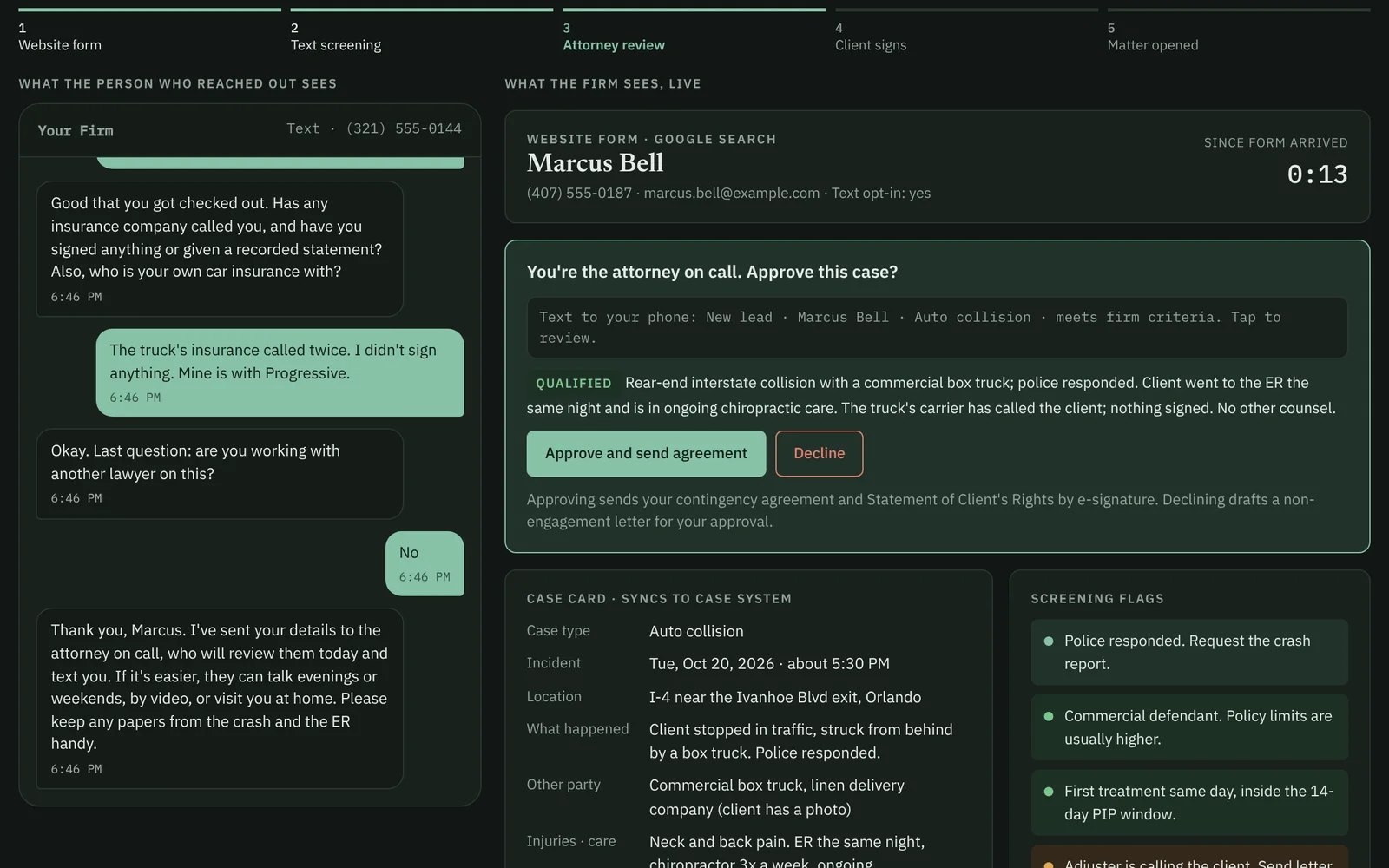
These are working demos with sample data, not a shipped product. The Sable Law intake demo takes a web form, screens the lead by text, and puts the lead in front of an attorney to approve or decline. If the attorney approves, the client e-signs, including Florida’s Statement of Client’s Rights, and the matter opens. The screening flags the two-year limitations period and the 14-day PIP window so they are on the first screen rather than found later.
The case desk covers what happens after the signature. It sends records and bills requests with follow-ups at 10 and 20 days, texts clients a weekly check-in, reads medical records into a treatment chronology, and tracks PIP, liability limits and health-plan liens. A readiness meter shows when a case is ready to hand to whoever writes the demand, whether that is the firm or a service such as EvenUp.
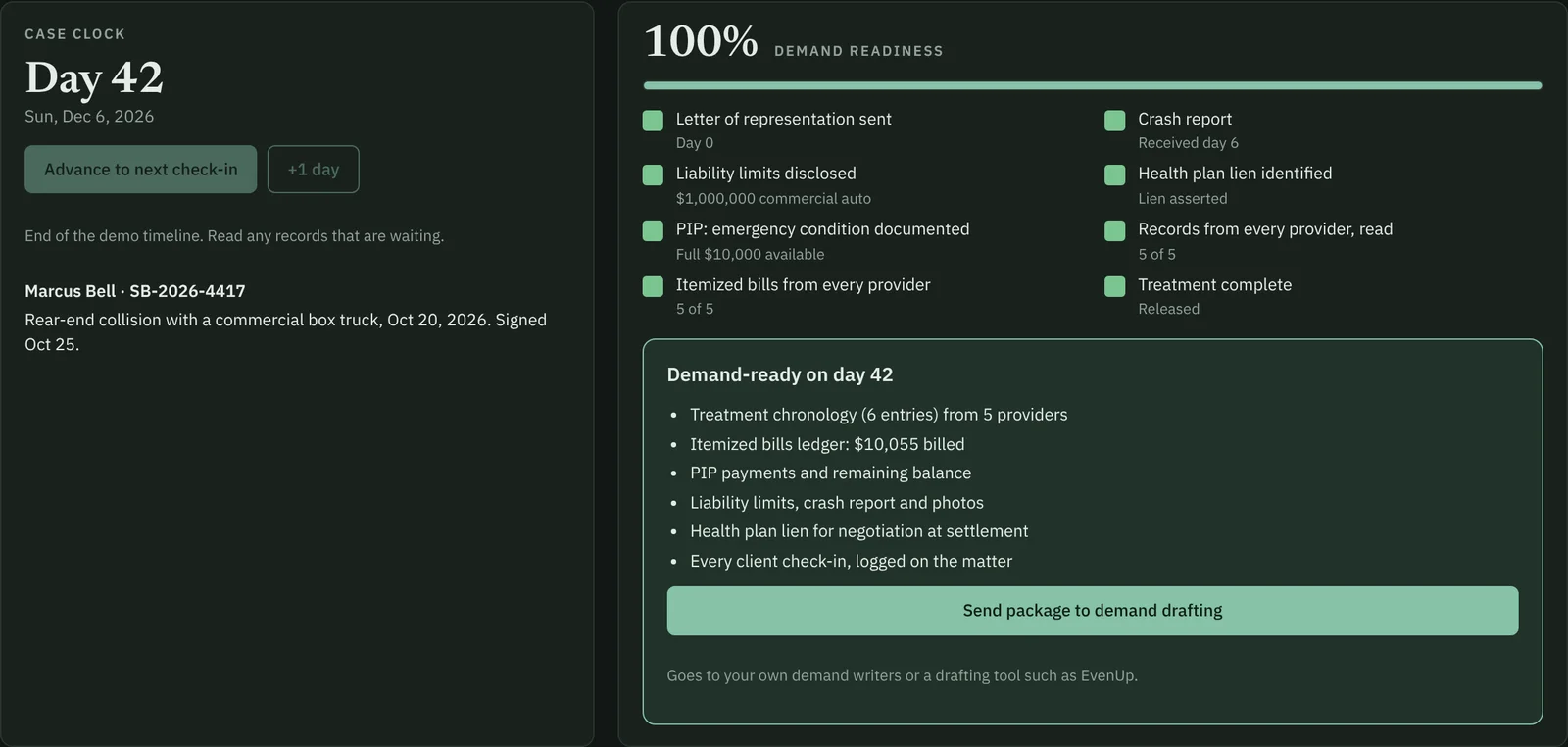
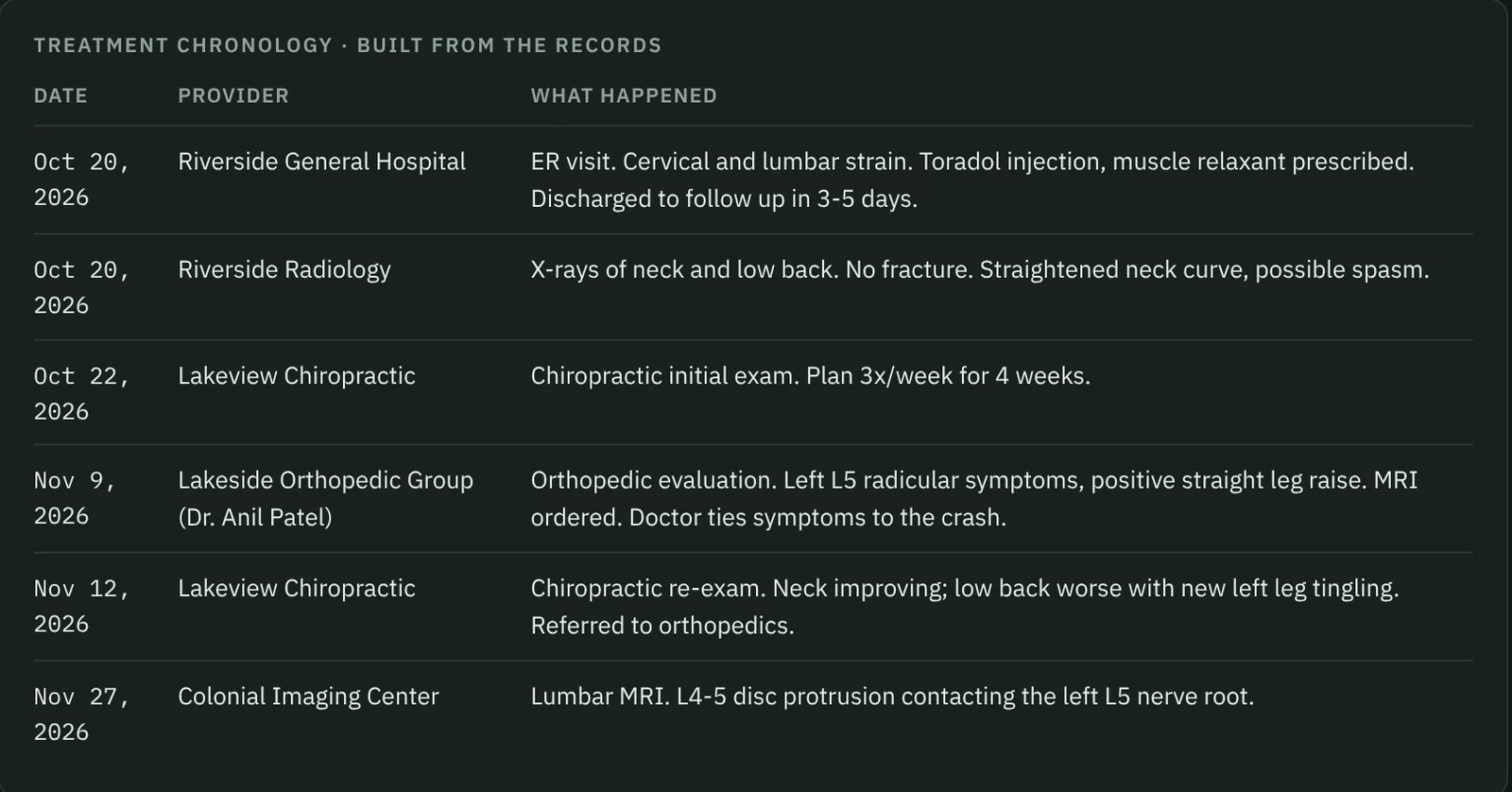
Nothing goes to a client or a carrier until a person at the firm approves it.
What to check at your own firm
- Submit your own web form from a phone tonight and time the first human or automated reply
- Write down who sees a lead at 9 p.m. on a Saturday, and what that person can do
- Check whether intake asks the date of the crash and the date of first treatment
- Count the days between signature and the first records request on your last five cases
- List who approves each message that goes to a client or a carrier
None of this is legal advice, and it does not promise any result on a case. Your state bar’s advertising and AI guidance still applies.
Sources
- Hennessey Digital, 2025 Lead Form Response Time Study (Q1 2025, 1,333 firms)
- Hennessey Digital, 2024 Lead Form Response Time Study (Q1 2024, 1,377 firms)
- Hennessey Digital, 2023 Lead Form Response Time Study (Q1 2023, 1,300 firms)
- Greenberg Traurig, “Tort Reform Overhauls Florida’s Litigation Landscape” (Apr. 20, 2023)
- Florida Senate, Fla. Stat. 627.736, Required personal injury protection benefits (2024)
- Supio, “Supio Unveils Major AI Product Expansions at Supio Summit 2025,” Business Wire (Sept. 18, 2025)
Bring one real intake. We time it with you.
The free scoping call is 60 minutes by video or phone. We walk one real intake and one inbox morning with sample or redacted data, and within 48 hours you get a two-page memo with what to fix first and a fixed quote in writing. If you do not go forward, you keep the memo.
Book the free scoping call