The work after the bid, measured.
One firm, four days, 5.5 logged hours. Everything on this page comes from the client’s own timestamped work log and the public award record, with identifiers removed.
Beyond the Bid: What We Built Next for the Same Firm.
The quote was the start. Since then we have run the firm’s federal pipeline end to end: finding what to bid, shaping requirements before they’re written, and getting onto contracts too big to prime alone.
About 140 Notices In, Three Worth Bidding Out.
We screened every active SAM.gov notice in the firm’s security codes and narrowed it to three real fits, each with a draft package ready: technical and price volumes, a gap list, site-visit and contracting-officer emails, and the Section 889 representation.
In Front of the Buyer Before the Solicitation Exists.
For a Navy market survey on security equipment at a Florida base, we wrote the firm’s response and the government’s company form, with seven observations on the draft requirement. That is how a small firm gets known to the buyer before competitors see a notice.
A Way onto a Contract Too Big to Prime.
For a nine-figure federal guard recompete, we used public award data to identify the incumbent and four likely primes, found the right contact at each, and built the capability statement and teaming emails that pitch a defined set of posts the firm can staff.
Paperwork That Holds Up Before Anyone Asks.
Federal and commercial capability statements, a SAM.gov registration review that matched every draft to the legal entity name, and license and insurance documents checked against every claim before it went out.
Measured on the Work: SableLabs Tech vs. by Hand
Hours come from the firm’s timestamped work log, October 17 to 20. The by-hand column is our estimate of how long a capable person would take without AI tools, and it is labelled that way in the client’s own report.
of SableLabs Tech work for everything on this page: registration, screening, two capability statements, teaming outreach and a Navy response.
is what the same work takes by hand, by our estimate. That’s a full work week of a small firm’s time.
less time, at either end of the by-hand estimate. The firm paid for 5.5 hours of work instead of a week of someone’s time.
for the Navy sources-sought response, against 10–16 hours for an experienced writer and 20+ for a first-timer. Submitted 10 days early.
| Work | What was delivered | SableLabs Tech | By hand (est.) |
|---|---|---|---|
| SAM.gov registration | NAICS codes and a business development contact added, so the firm qualifies as small for guard work | 0.5 hr | 1–2 hrs |
| Screening and forecasting | Initial scan, rescan with new codes, deadline rechecks, recompete forecast from USAspending | 1.75 hrs | 8–12 hrs |
| Teaming package | Teaming plan, requirements brief, license and insurance review | 0.75 hr | 4–6 hrs |
| Capability statements | A teaming version and a general version, each fitted to one page | 0.5 hr | 4–6 hrs |
| Outreach | Contact research, emails to primes and the contracting office, a referral follow-up | 1.0 hr | 4–6 hrs |
| Sources-sought response | Response, the Navy’s own form, technical research, final audit | 1.0 hr | 10–16 hrs |
| Total | All of the above | 5.5 hrs | 31–48 hrs |
What a Manual Review Would Likely Have Missed
Speed is half of it. The other half is reading every document against every other document and checking each claim against its source. On this one firm, in four days:
| Caught | Where | What it would have cost |
|---|---|---|
| The Navy required its own company form, and brochures were not allowed | Sources-sought instructions | Either one disqualifies the response before anyone reads it |
| Seven errors in the government’s own specifications, from an outdated encryption standard to an operating system that loses support mid-warranty | Salient characteristics, verified against NIST, Microsoft and DoD sources | A missed chance to show expertise to the buyer, and a requirement bid inconsistently |
| A records mismatch between two of the firm’s official filings | License vs. SAM.gov records | A prime’s due diligence finds it first, and the teaming slot goes to someone else |
| Two contracts the firm could not win: a 4-hour on-site response radius 5–6 hours from the nearest office, and a mandatory site visit | Performance work statement, synopsis | Days of bid effort spent on a loss, or a win the firm couldn’t perform |
| A missing NAICS registration that would have blocked small-business eligibility | SAM.gov registration | Not eligible as a small business for the work being pursued |
What You’d Be Paying For
Pages from the delivered work, set on our letterhead with the client’s name, branding, identifiers, sites, contacts and notice numbers redacted.
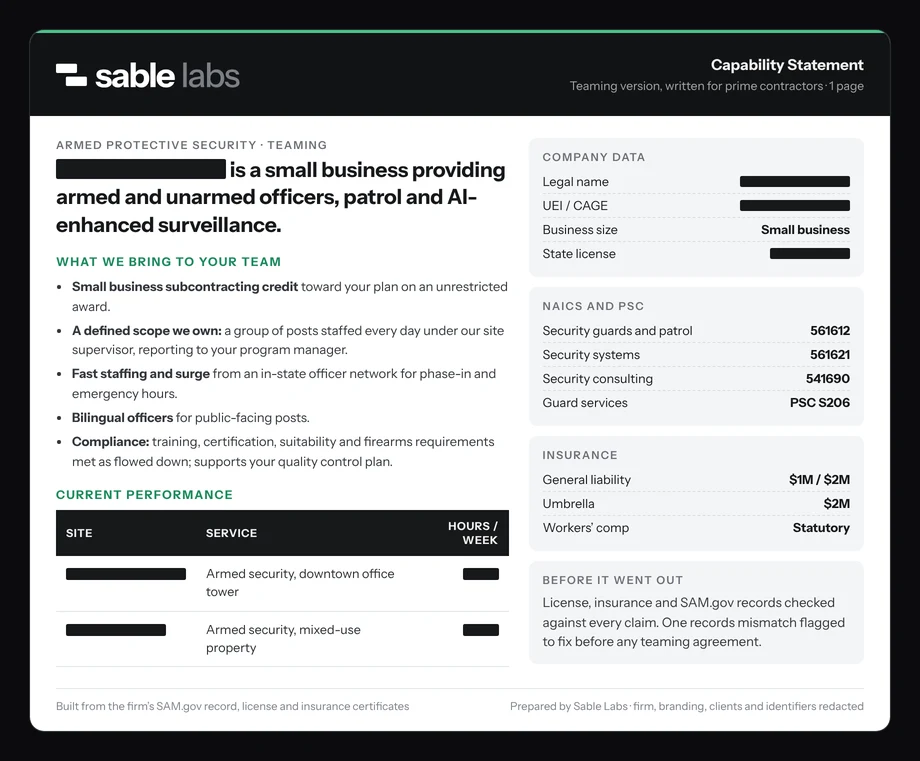
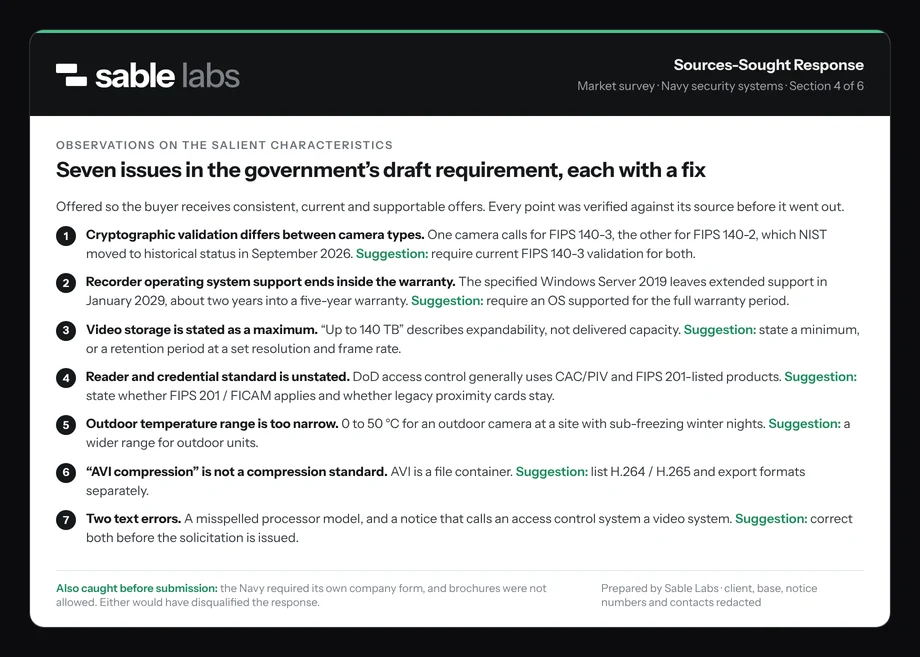
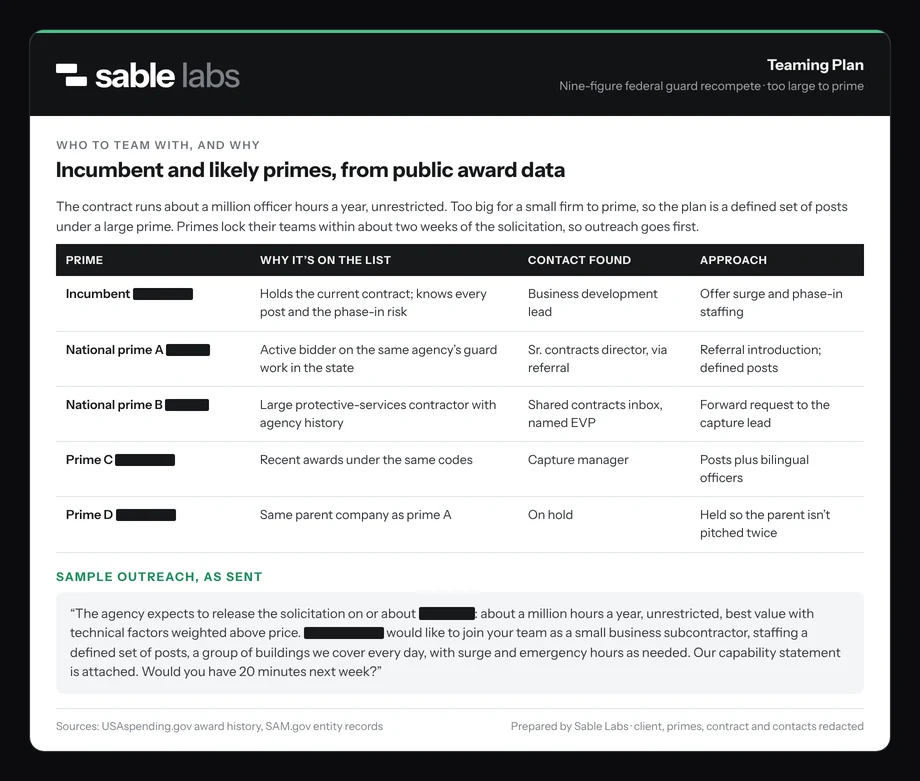
The firm is not named, and pursuits still open are not claimed as wins.
Why Bids Lose, and Where We Come In
The field is smaller than it looks, and most of it is lost on paperwork, not price. Here is what the public record says, and what it means for a firm with no proposal staff.
small businesses won a federal prime contract in FY2025, down from 65,428 in FY2021. Fewer firms are still in the game; the ones that stay are the ones that can get a compliant package out the door.
in prime contracts went to small businesses in FY2025, nearly 28% of all federal prime dollars. The money has not left. The bidders have.
is the median field on a set-aside award in our target NAICS codes over the last 12 months (339 awards, $256M). Half of them had three bidders or fewer; 29% had exactly one.
is what a proposal team averages per response. A two-person security firm does not have 30 hours between service calls, so the bid never goes in.
How a Bid Actually Loses
Evaluators eliminate before they compare. In a simplified acquisition the contracting officer screens every quote for responsiveness first, and only the survivors are scored on price or technical merit. These are the ways a quote fails that screen, and every one of them is a paperwork failure, not a capability failure.
| How it loses | What happened | What we do about it |
|---|---|---|
| Late | Portals close at the minute. Amendments move due dates and the synopsis still shows the old one. | Every government document is reconciled against every other one before a word is written. A due-date conflict is the first thing the gap list reports. |
| Non-responsive | A “shall” went unanswered, a page limit was exceeded, a required section was skipped, an attachment was unsigned. | The requirements crosswalk lists every “shall” and “must” with a Meets / Exceeds / Partial answer and a page reference. Nothing is answered by implication. |
| Missing certifications | FAR 52.204-24/26, 52.212-3 reps, Section 889, small-business status: absent or stale. | FAR certifications are drafted from the solicitation’s own clause list and checked against SAM.gov before the package is audited. |
| Answered the wrong requirement | Q&A answers cite terms that are not in the SOW; the spec sheet still describes a competitor’s product. | Q&A, amendments and the SOW are read as one document. Phantom requirements get flagged, and the technical response is written to what the government actually asked. |
| Never bid | The notice was up for 15 days and nobody at the firm saw it. The incumbent’s recompete came and went. | The Bid Desk retainer screens SAM.gov daily in your NAICS codes and states, scores every match, and keeps a recompete calendar for the contracts you already hold. |
When a rejected bidder protests, GAO’s own FY2025 report lists “unreasonable rejection of proposal” as a top-three sustained ground for the first time, and only 14% of protests decided on the merits are sustained at all. The cheaper fix is a package that never gives the contracting officer a reason.
What the Alternatives Cost
| Option | Typical cost | What you get |
|---|---|---|
| Proposal consultants | $3,000 to $25,000 per proposal, or $2,500 to $15,000 a month | Experienced, slow, and the premium shops are leaving the writing business. |
| AI proposal software | $24,000 to $60,000 a year | Built for firms bidding 40+ times a year with a proposal team to run it. |
| Freelance marketplaces | $10 to $50 per gig | You get what you pay for. Compliance errors are discovered by the contracting officer. |
| Doing it yourself | 30 hours of the owner’s time, per bid | Or, more often, the bid that never goes in. |
| Sable LabsRFQ response | $1,950 per RFQ, flat | Gap list first and free. Full package in 48 hours: crosswalk, technical response, FAR certs, priced schedule, page-by-page audit. Built by the same process that produced a federal quote from a cold start in under four hours. |
| Sable LabsBid Desk | $6,000 a month | Five audited bids a month, daily SAM.gov screening with a bid / no-bid score, two past-performance reviews a month, recompete calendar. A bid desk without the hire. |
Sources: Washington Technology on the SBA FY2025 scorecard (vendor counts) · SBA FY2025 scorecard release ($179B, 28%) · Inc. on the shrinking contracting base · GAO FY2025 bid protest report via SmallGovCon · Loopio 2024 RFP Trends (hours per response) · Sable Labs analysis of 339 set-aside awards, Oct 2025–Oct 2026, from USAspending.gov award records in NAICS 561621, 561612, 561210, 561720, 238210 and 541519.
Start with the free gap list.
Send any live solicitation. Within hours you get the gap-and-risk list, free, and you keep it either way. Pricing for the full package is $1,950 flat for an RFQ.